A scientific architecture you can inspect

A shared space for understanding how systems change.

Gongjing (共境) is an experimental framework for people and scientific AI tools to work with the same computational representation of a system.

A computational worldspace keeps entities, states, influences, constraints, interventions and observations connected. The live case studies below show how a shared interface can organize different kinds of evolving models.

Live computational case studies · Runs in your browser
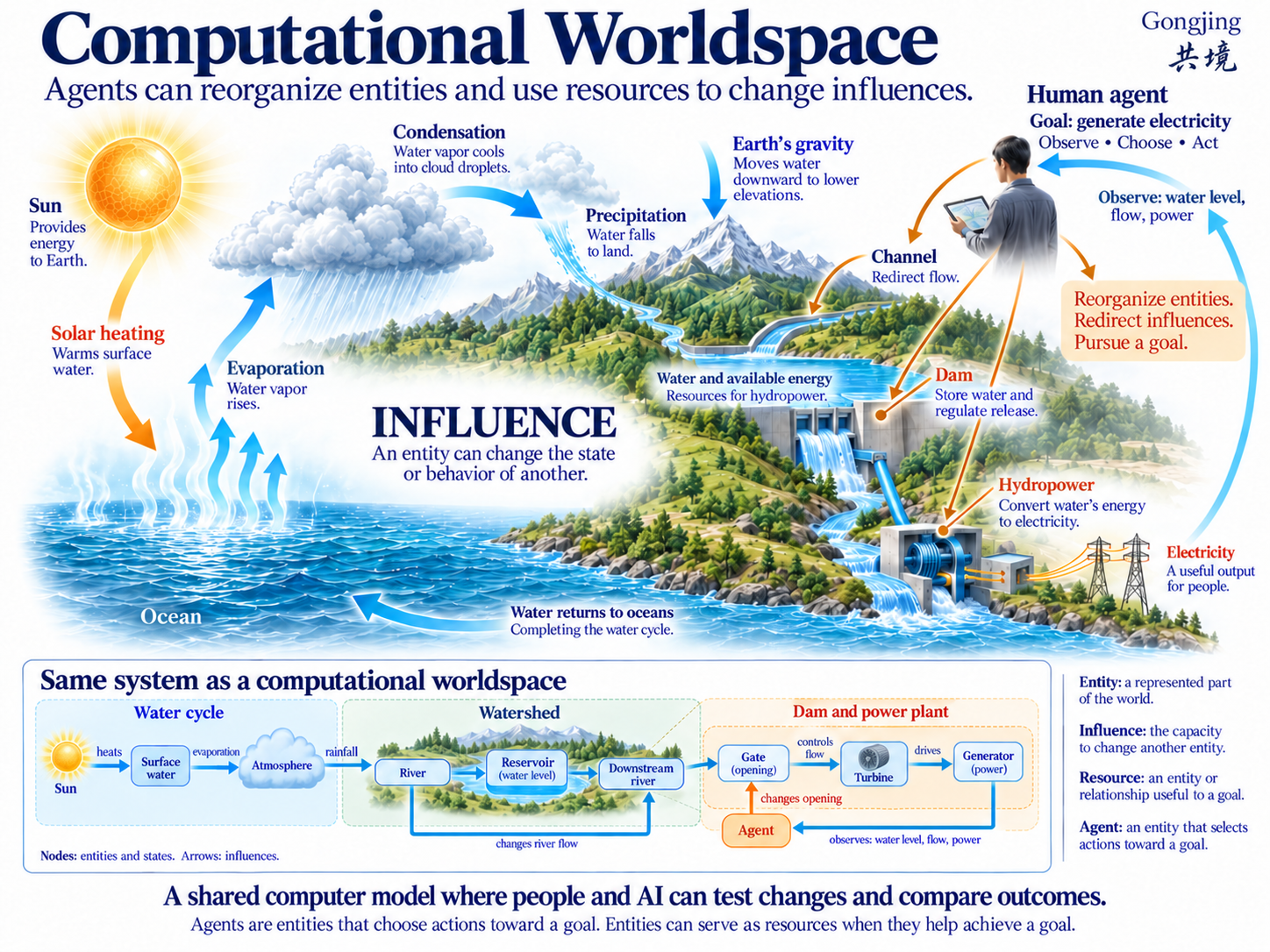
Computational worldspace illustrated through the water cycle, a watershed, and a hydropower system. Natural influences connect water, sunlight, gravity, land, and infrastructure. A human agent observes conditions and changes water flow through a channel and dam.
One connected model across scales.The water cycle, watershed, and hydropower system are represented as linked entities and influences. A human agent observes the world, uses resources, and changes selected influences to pursue a goal. The lower inset shows how the same system can be organized computationally for people and AI to inspect and test.Open the full-size figure

Explore the worldspace

No account or installation needed.

01 / INFLUENCE CELLS

Local rules, changing patterns.

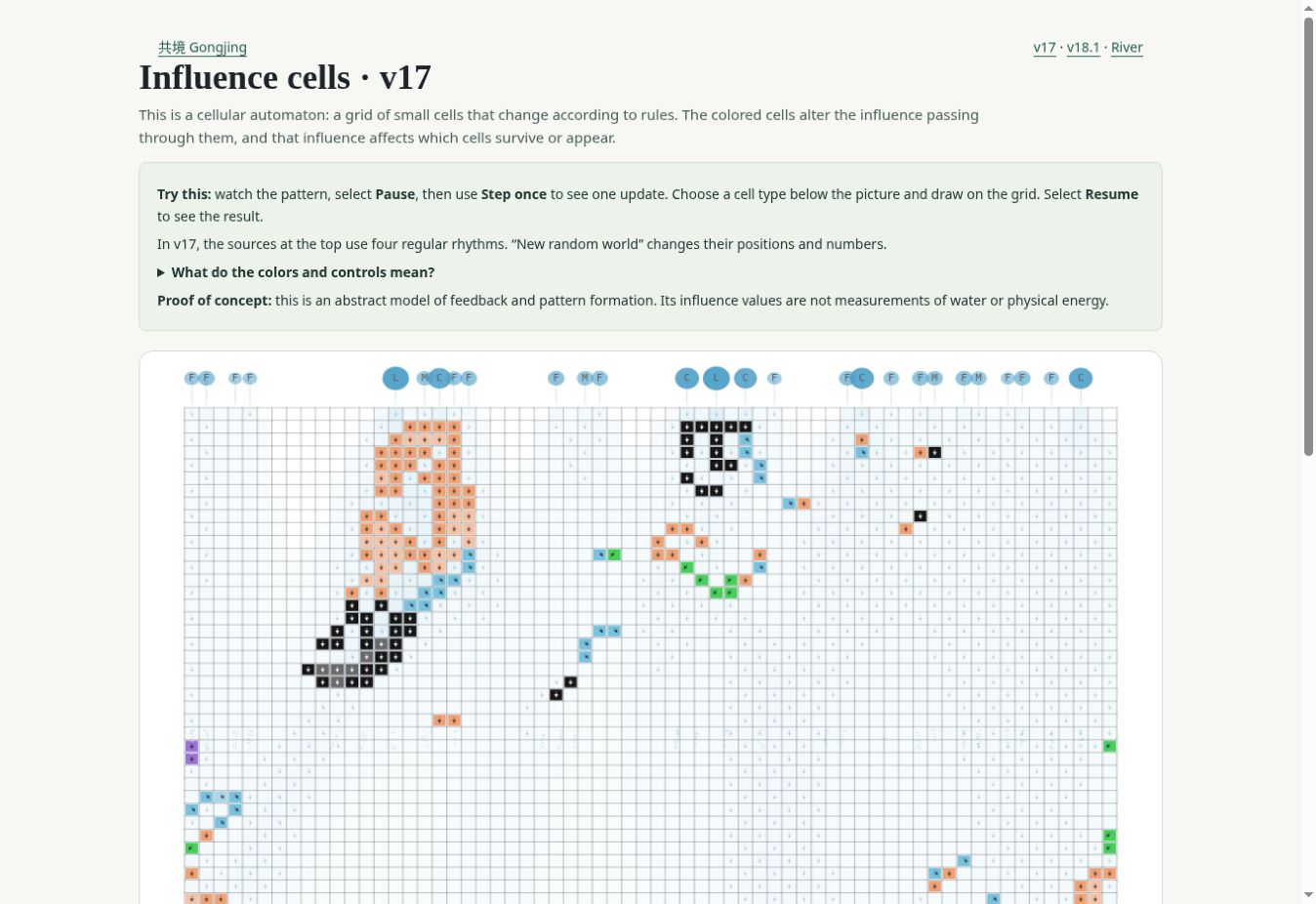
Version 17 starts with small colored cells and changing inputs from above. Cells change the influence passing through them. That influence helps determine which cells survive or appear.

Watch for: how a small local change affects the wider pattern.

Explore v17
02 / INFLUENCE CELLS

What if inputs change pace?

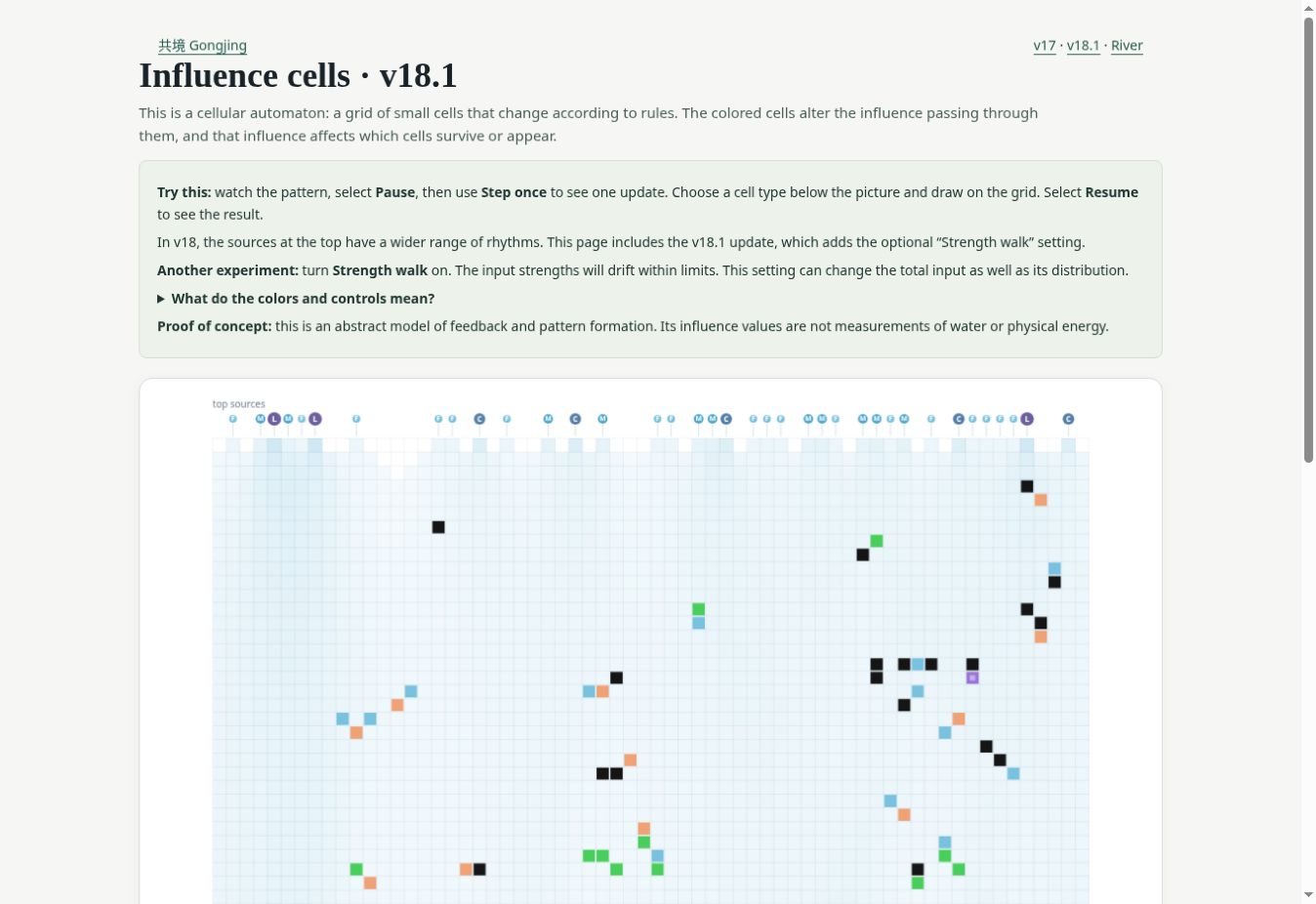
Version 18 gives the inputs a wider range of rhythms. The included v18.1 update also lets their strengths wander over time, so you can explore a changing environment.

Try: turn on “Strength walk” and watch how the cells respond.

Explore v18.1
03 / WATERSHED WORLDSPACE

Watch water reshape a landscape.

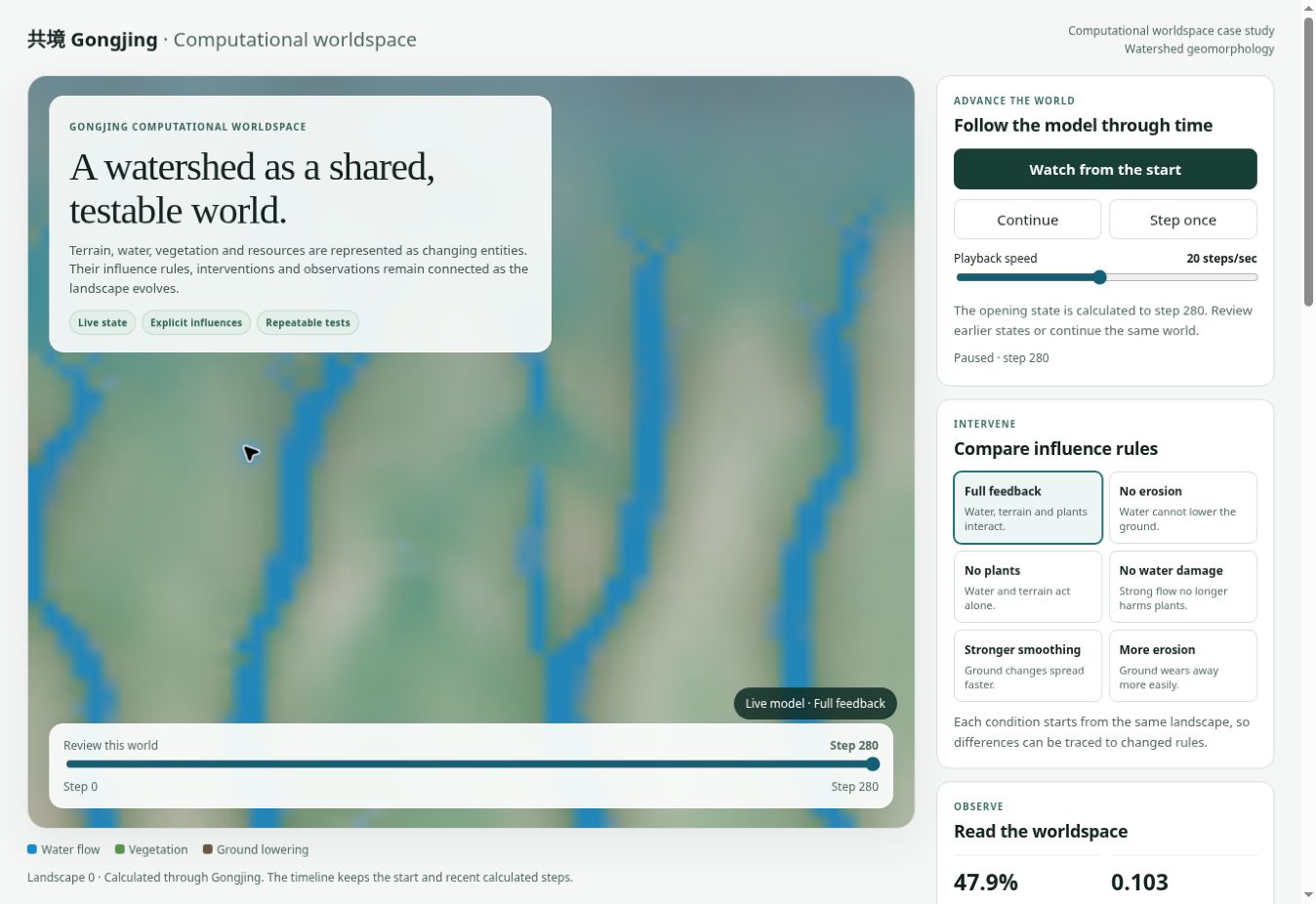
Water wears down the ground. The changed ground redirects water. Plants affect both processes. Gongjing connects the evolving state, influence rules, interventions and observations.

Compare: the same starting landscape with erosion on and off.

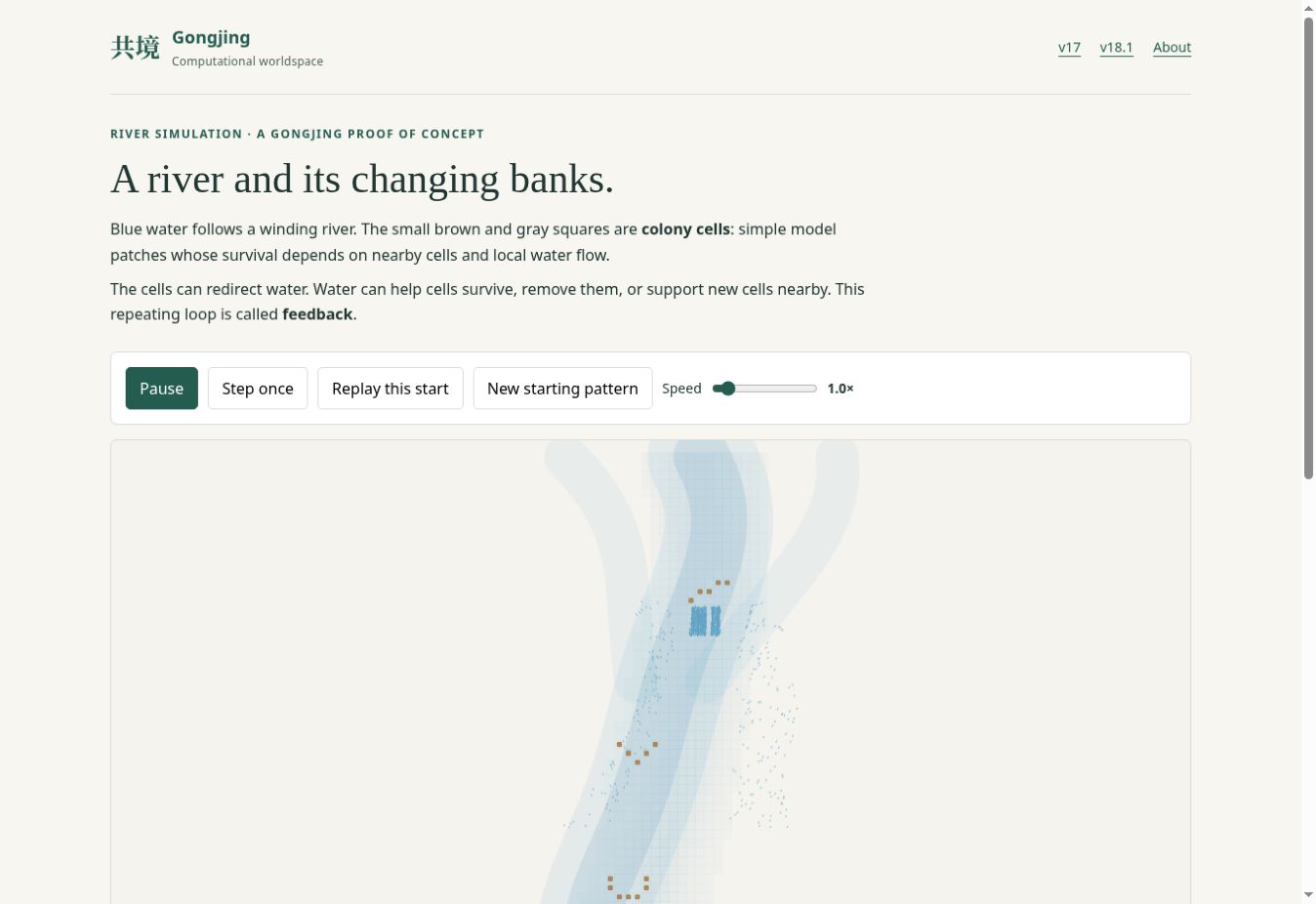
Related experiment: water and colony cells in a winding river.

Featured computational worldspace

One model, from evolving landscape to inspectable experiment.

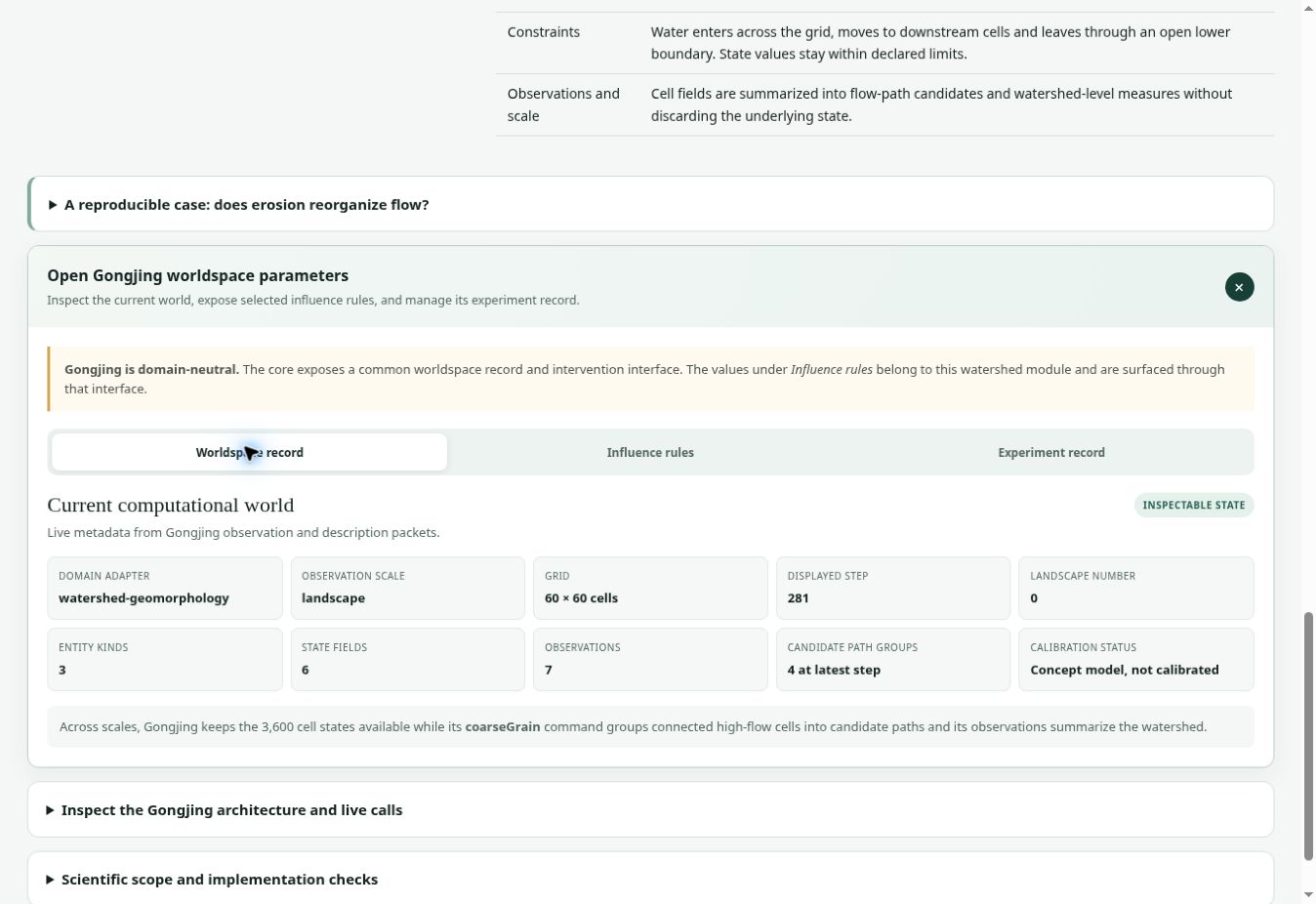
The watershed example keeps the visible landscape connected to its entities, influence rules, parameters, observations and intervention history. It is a compact demonstration of a reusable scientific architecture, not a forecasting model for a specific watershed.

The modular page shows how Gongjing separates its shared core from domain rules. The portable version packages the same working example into one HTML file for easy review and archiving.

Three more working examples

Each preview opens a live model.

What does Gongjing add?

A domain model calculates changes. Gongjing adds a shared structure for describing the modeled world, reading its state, applying permitted interventions, comparing outcomes and preserving the experiment record.

The watershed case shows this separation directly: the watershed adapter contains the domain rules, while the Gongjing core provides common commands for initialization, stepping, observation, description, intervention and cross-scale pattern summaries.

The longer-term aim is to let people and scientific AI tools explore, compare and explain models through the same interface. These pages demonstrate model behavior and software structure; they do not yet demonstrate an AI system carrying out independent research.
Read the results in context.

These are simplified, synthetic worlds. The cell model's influence is an abstract quantity. The river models use relative values and simplified flow rules. They have not been calibrated to a real river or ecosystem.

Use them to explore feedback and pattern formation. They are not tools for forecasting floods, making engineering decisions, or predicting real plant growth.

Read the project overview · Model and version notes